
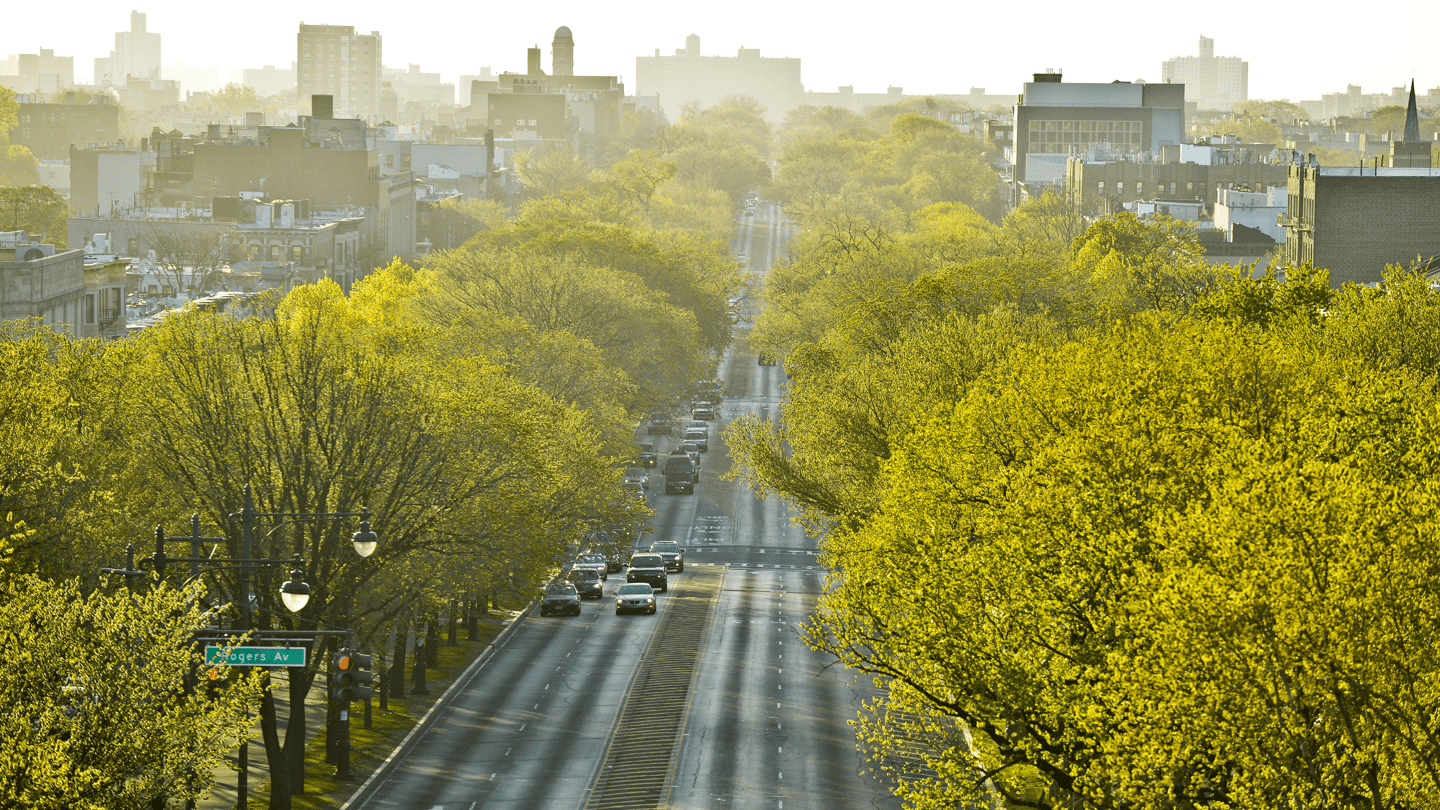
Trees lining Eastern Parkway, Brooklyn, NYC Parks, Daniel Avila
Every New Yorker should have access to shade from the sun, healthier air to breathe, and streets that can better manage stormwater. Investing in trees as infrastructure will help make it happen.
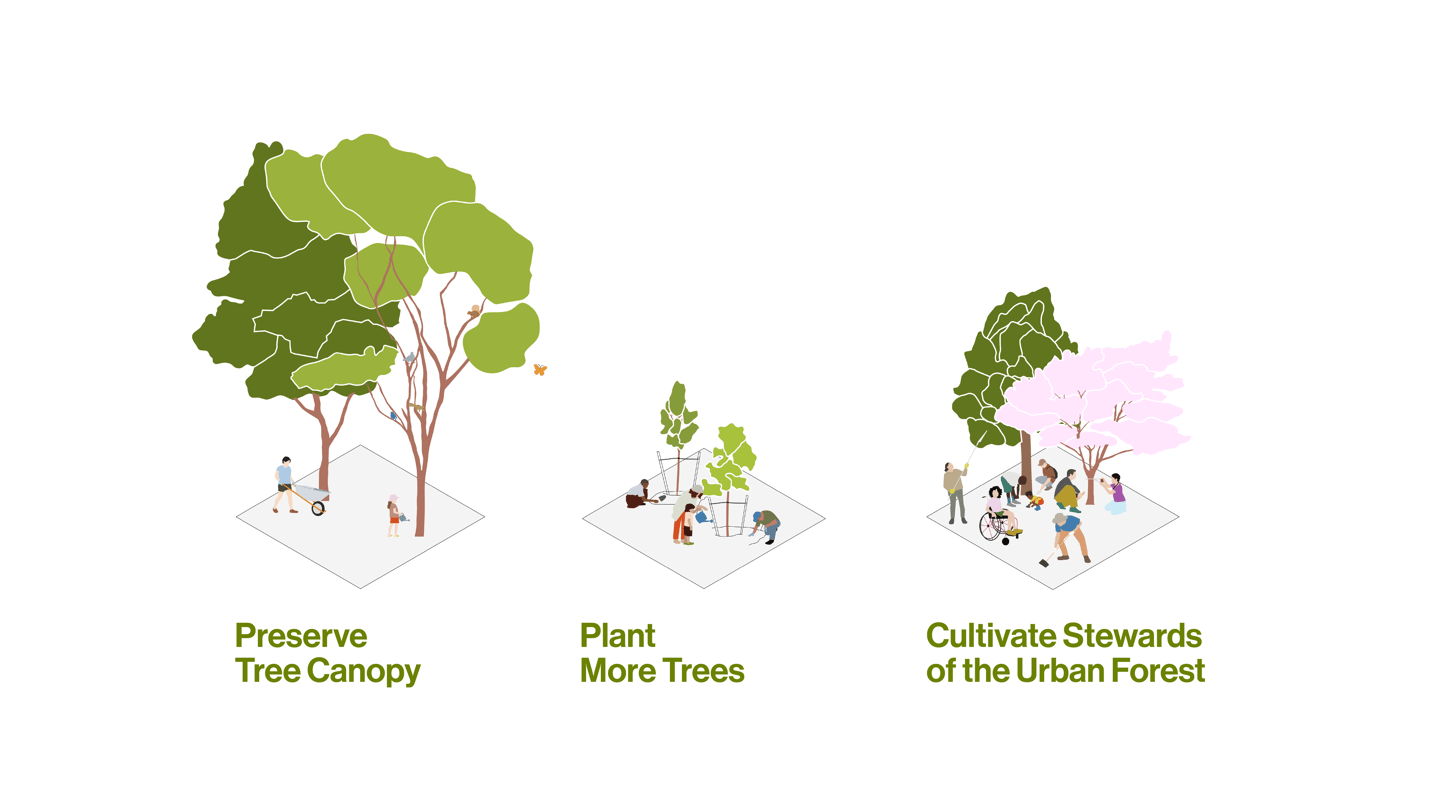
The UFP outlines three pathways toward achieving 30 percent canopy while involving more people and groups in caring for the urban forest.
Tree canopy covers 23.4 percent of New York City today. That equals roughly 45,000 acres spread unevenly across five boroughs. That figure obscures a sharper reality. Environmental Justice areas have a total of 19 percent canopy cover compared with 26 percent in non-EJ neighborhoods. We can trace this gap directly to redlining and decades of uneven public investment. Growing the canopy without addressing the uneven distribution between Environmental Justice and non-EJ areas would make the numbers look better while leaving the problem intact.
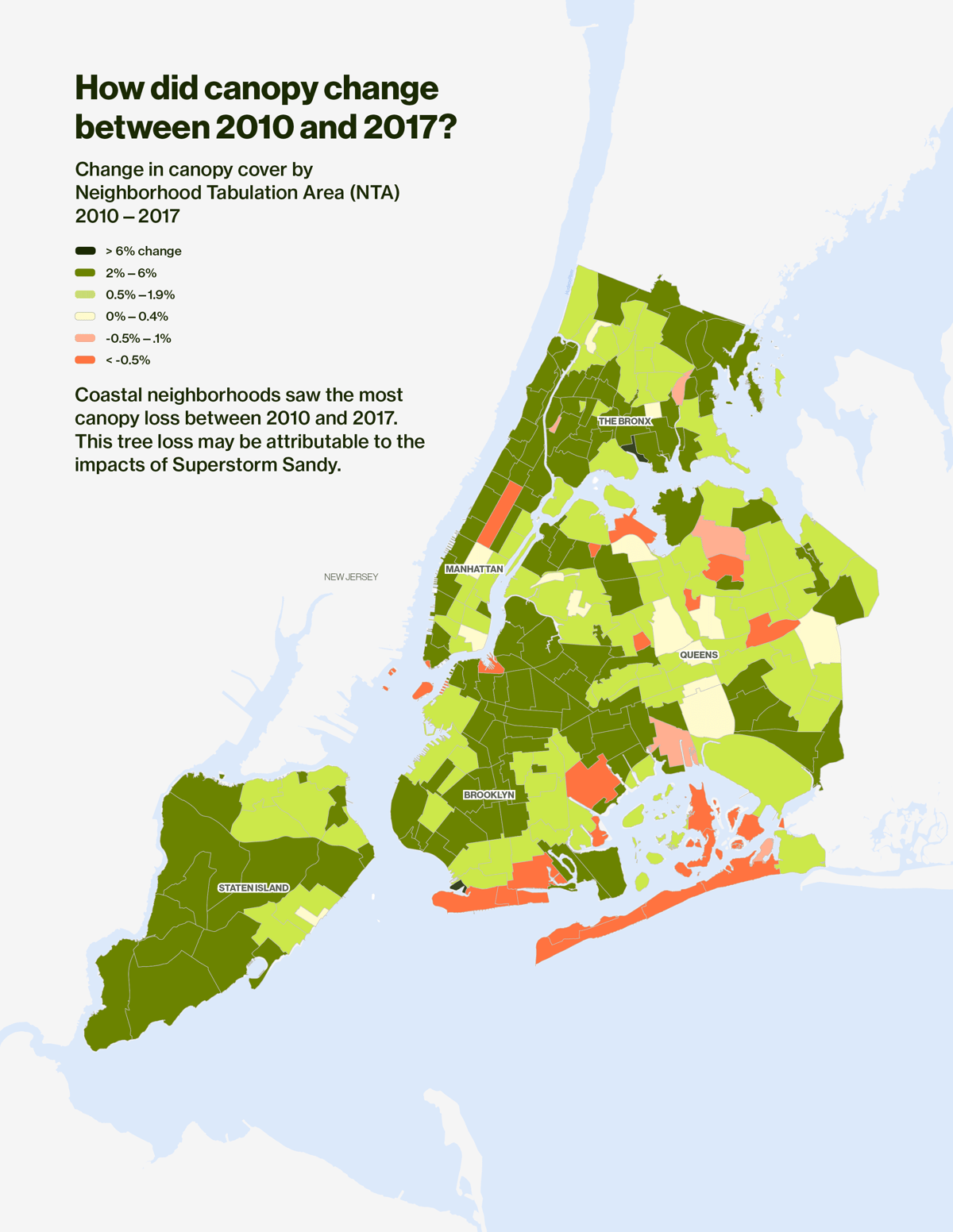
The NYC Urban Forest Plan, mandated by Local Law 148 of 2023, sets a goal of equitably reaching 30 percent canopy citywide by 2040. WXY with collaborators Urban Canopy Works, joined a project team that included MOCEJ, NYC Parks, The Nature Conservancy, Natural Areas Conservancy, City Parks Foundation, and Partnerships for Parks to support the public engagement process and design the analytical structure that makes the plan actionable. Formulating a comprehensive, effective plan required going beyond usual urban planning practice. The process had to translate community priorities into policy, and data into decisions that hold up under political and budgetary pressure.
The plan is organized around three pathways: Preserve Tree Canopy, Plant More Trees, and Cultivate Stewards of the Urban Forest. Together, they connect protection, expansion, and long-term care, making clear that none of these efforts work in isolation. The structure builds on years of coordination across agencies and community partners, bringing those efforts into a single framework that aligns policy, investment, and stewardship.
Two-thirds of existing canopy sits on public land, but 68 percent of the easiest new planting opportunities are on private property, particularly one- and two-family homes.
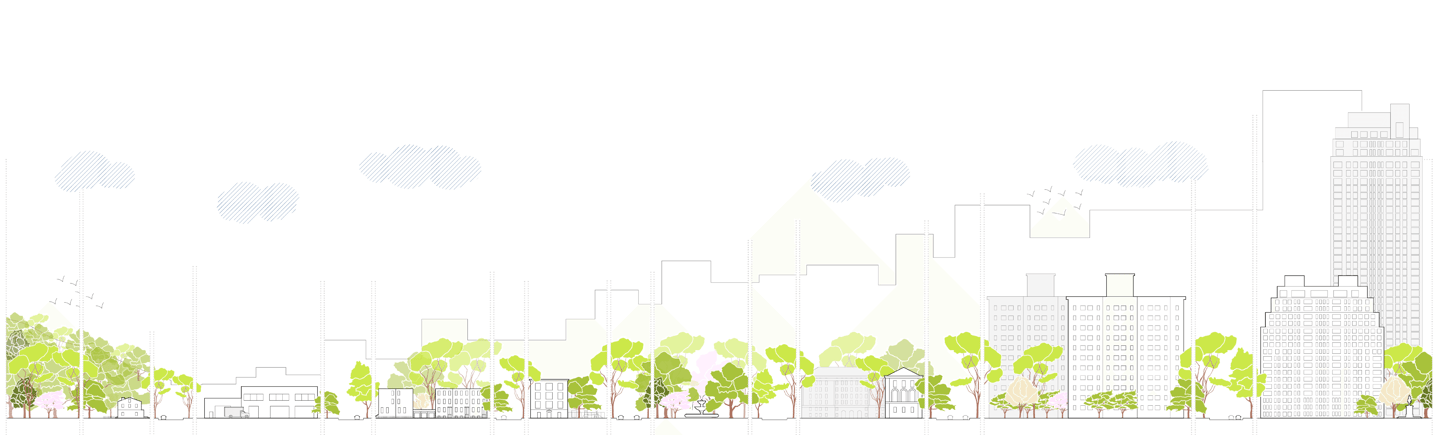
Illustration of trees and property types across New York City
The fastest path to 30 percent would have been to plant where growth is easiest, in neighborhoods that already have a relatively high canopy. WXY’s analysis showed that the approach would deepen current disparities rather than address them. The plan instead targets assistance programs for homeowners and managers of trees on private property, and a NYC Tree Canopy Challenge directed at hospitals, universities, faith institutions, and cemeteries among other strategies to preserve and expand canopy on private property.
At the same time New York City will seek to preserve existing canopy and plant more trees within properties that it directly controls such as on land owned by agencies as well as on public streets and sidewalks.
The engagement process ran from winter 2024 through fall 2025, reaching more than 8,000 New Yorkers across 50 public events and a citywide questionnaire available in ten languages.
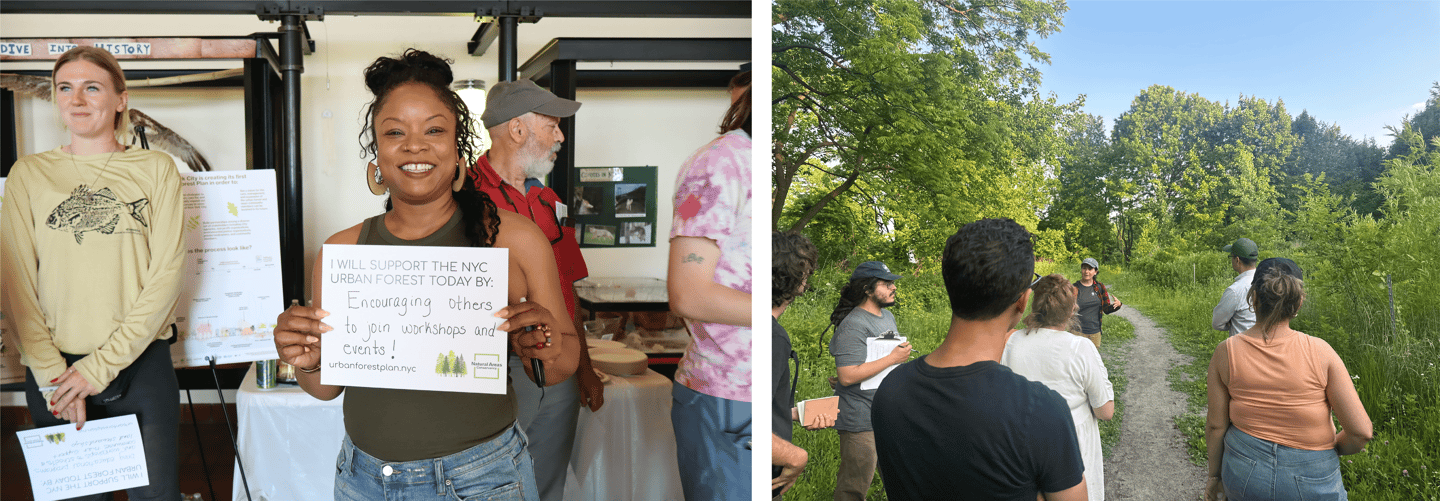
UFP workshop and participants, NAC
The harder work was what came after: distilling over 20,000 individual comments and over 150 recommendation ideas into 43 implementable actions organized across 12 initiatives and three pathways. Nearly 70 percent of respondents named equitable tree distribution as their primary hope for the urban forest. That response informed the plan’s equity framework and served as its basis.
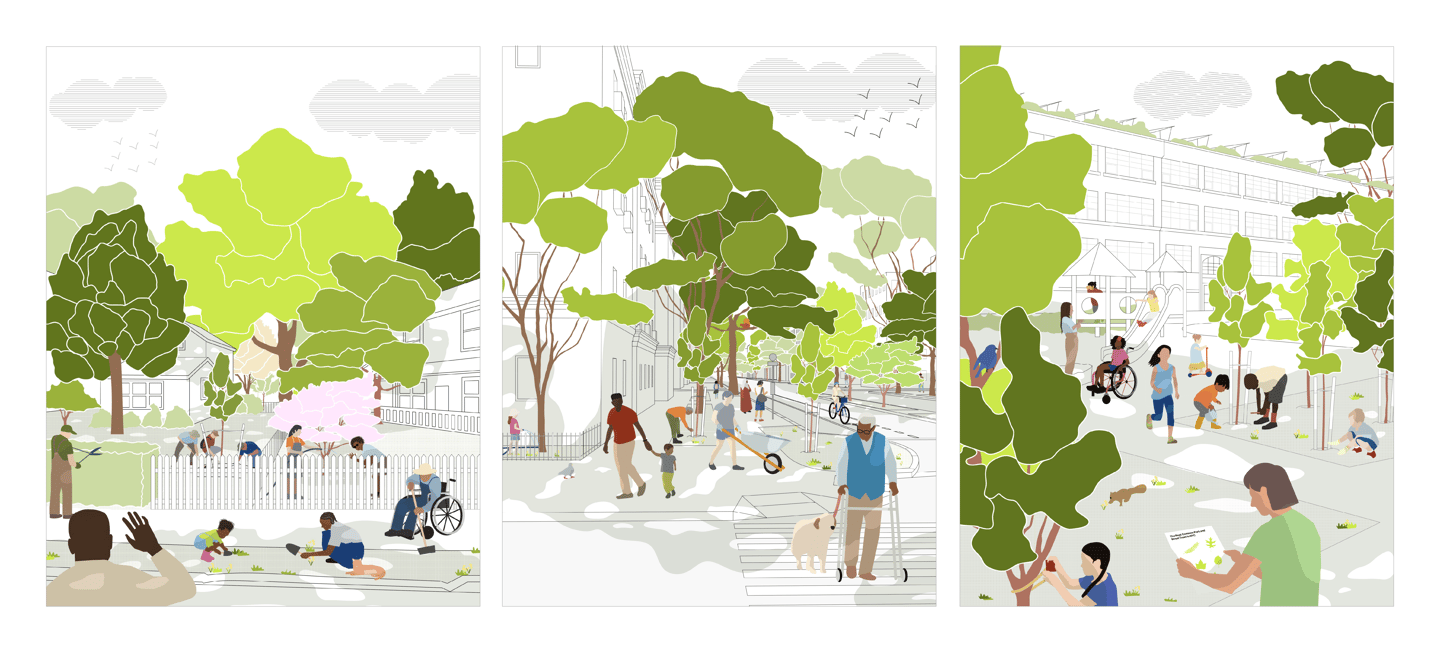
The pathways, strategies, and actions that follow represent a comprehensive approach to equitably expanding tree canopy citywide to 30 percent by 2040.
NYC’s urban forest already generates an estimated $260 million in benefits through air pollution removal, stormwater management, carbon sequestration, and reduced energy costs, against a replacement value of $5.7 billion. Reaching 30 percent canopy requires adding approximately 700 net acres per year, up from the current rate of 579, the equivalent of 50 completely forested city blocks every year for 14 consecutive years. Growth on public lands is already close to the pace needed.
The gap is on private land, where 1-2 family homes are the only property type currently experiencing net canopy loss. The plan’s policy tools, financial incentives, and stewardship programming are built to address that gap in the neighborhoods where it matters most.
Funding provided, in part, by the USDA Forest Service in partnership with American Forests; The Leona M. and Harry B. Helmsley Charitable Trust; and the Anahata Foundation.
Claire Weisz Architects LLP
d/b/a WXY architecture + urban design
212 219 1953
office@wxystudio.com
Careers ↗
New York
25 Park Place, 5th Floor
New York, NY 10007
Toronto
30 St. Patrick Street, 5th Floor
Toronto, ON M5T 3A3 Canada
Subscribe to our newsletter
Site designed by Clinton Van Arnam
Developed by Mario Giampieri