
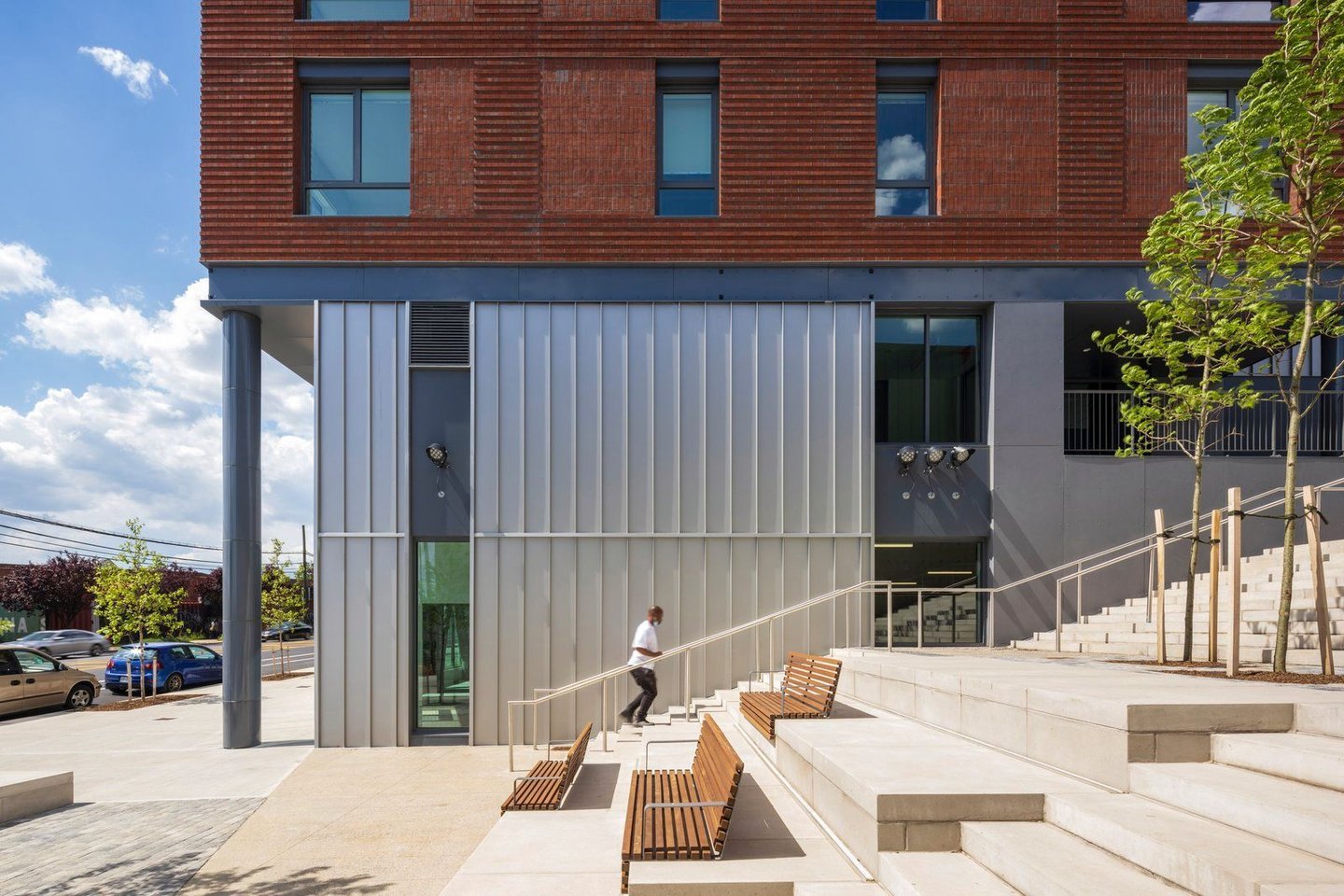
Terraced steps offer inviting public space for relaxation, social gathering, and connection.
For decades, a block in Hunts Point stood as a reminder of disinvestment and confinement. The site of the former Spofford Youth House, once notorious and then simply abandoned, has been transformed into something radically different. This is now a lively campus where affordable housing, light industry, and public space coexist. The Peninsula does not just replace a detention center with new buildings. It rewrites the story of a neighborhood.
WXY, working in partnership with Body Lawson Associates, helped shape a vision that grew from community workshops and civic ambition. From the earliest conversations in 2016, the project was conceived as a place where residents could not only find a home but also start a business, enjoy a meal, and spend time in generous green spaces. Today, that vision is taking form across nearly five acres and three phases of construction.
At full build-out, The Peninsula will offer 740 affordable apartments, all income-restricted, along with more than 75,000 square feet of commercial and community facilities. The buildings frame a central plaza anchored by a fresh food market and a health center, bridging everyday needs with a sense of civic belonging. Alongside new homes, a two-story manufacturing hub with its distinctive sawtooth roofline accommodates food producers and media studios, mixing economic opportunity with local culture.
This convergence of uses challenges traditional zoning that keeps industry at a distance from housing. Here, clean fabrication and production spaces sit comfortably beside family apartments. Shared infrastructure, including loading docks and flexible mechanical systems, makes room for small enterprises to thrive without displacing residents.
The design reflects an attention to detail that feels both grounded and ambitious. Brick, metal, and glass fiber concrete reference the industrial legacy of Hunts Point while signaling a future built on inclusion and resilience. Green corridors and planted terraces soften the edges of the buildings and absorb stormwater, a practical gesture that also elevates daily life.
The recent publication of Dual Cities: A Study of Social Housing in London and New York, by Paul Karakusevic and Mike Althorpe, underscores how projects like The Peninsula belong to a broader transatlantic conversation about housing equity and urban reinvention. As both cities grapple with soaring costs and deepening inequality, this work offers a model for turning overlooked sites into engines of opportunity. It suggests that large-scale transformation can remain accountable to neighborhood aspirations and that design, at its best, can expand the possibilities of what a city block can hold.
The design reflects an attention to detail that feels both grounded and ambitious. Brick, metal, and glass fiber concrete reference the industrial legacy of Hunts Point while signaling a future built on inclusion and resilience. Green corridors and planted terraces soften the edges of the buildings and absorb stormwater, a practical gesture that also elevates daily life.
Explore more about The Peninsula project.
Claire Weisz Architects LLP
d/b/a WXY architecture + urban design
212 219 1953
office@wxystudio.com
Careers ↗
New York
25 Park Place, 5th Floor
New York, NY 10007
Toronto
30 St. Patrick Street, 5th Floor
Toronto, ON M5T 3A3 Canada
Subscribe to our newsletter
Site designed by Clinton Van Arnam
Developed by Mario Giampieri