
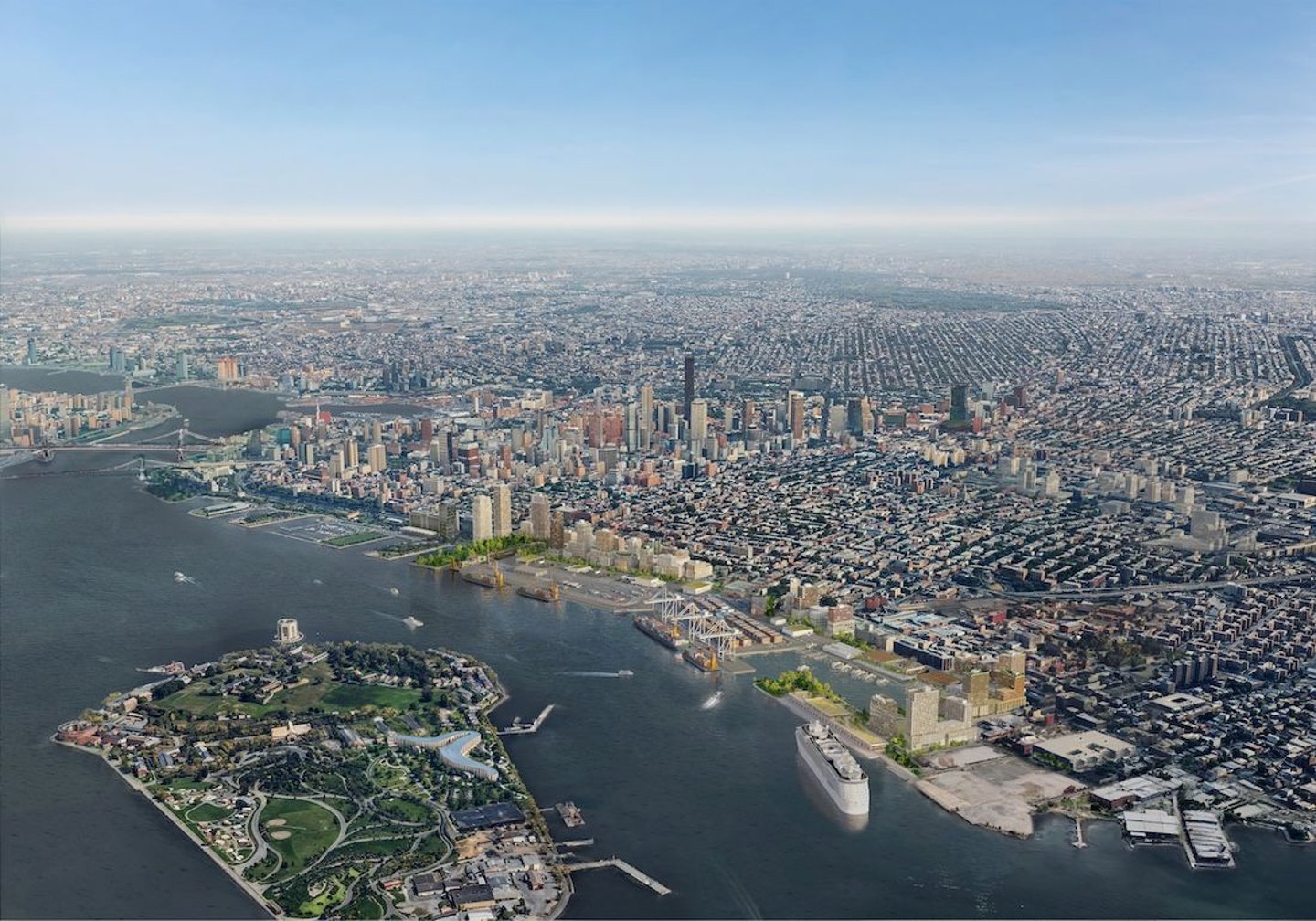
Aerial rendering of the Brooklyn Marine Terminal.
The future of waterfront cities hinges on their ability to reconcile competing needs: global trade, local housing, climate resilience, and community life. Around the world, working ports sit at this crossroads. The question is no longer whether to adapt but how.
The Brooklyn Marine Terminal offers one answer. At 122 acres, it’s a site where regional infrastructure is enmeshed with neighborhood streets, where container trucks meet the promise of new housing and open space. This year, the Brooklyn Marine Terminal Task Force approved a vision plan that charts a course for transformation. This will be a 60-acre port paired with a mixed-use district of 6,000 homes, 28 acres of public space, modern industrial facilities, and resilient, walkable streets.
“This is a rare chance to repair a working port while also creating housing, open space, light manufacturing, industrial workspace, and streets that serve the people who live here,” said Claire Weisz, Founding Principal of WXY. “The design grew out of conversation, thousands of voices refining and reshaping ideas until the pieces fit together.”
That spirit of dialogue shaped the engagement process, which reached more than 3,000 New Yorkers in a condensed timeline. WXY led multilingual focus groups, NYCHA bus tours, and targeted canvassing with Green City Force, alongside surveys and interactive tools that let residents test scenarios and see the impact of their choices. “We developed interactive tools that gave people a way to see the impact of their choices,” said Chris Rice, Associate Principal. “Whether it was truck routes, new commercial hubs, or public space along the water. People could see their ideas take place in front of them. That instant feedback was important in moving the project forward.”
At the same time, WXY guided the site’s urban design strategies, shaping a framework that ties housing, commercial corridors, and affordable industrial space into a connected waterfront neighborhood. The team collaborated with Buro Happold, One architecture + urbanism, SCAPE, TY Lin, Creative Urban Alchemy, and others to define recommendations for housing, public space, density, and resiliency.
“Urban design strategies at BMT focused on building connective tissue between neighborhoods,” noted David Vega-Barachowitz, Associate Principal and Director of Urban Design. “This project has the potential to favor people over cars, build active ground floors that welcome activity and provide services, and establish a novel strategy that redefines a mixed-use waterfront through a strategic combination of modern industrial space and market-rate and affordable housing.”
“This has always been a project about scale,” added Adam Lubinsky, Principal. “The Brooklyn Marine Terminal sits at the intersection of regional, city, and local needs, and the challenge was to design for all three at once. Cities change when big plans meet everyday realities, and this vision shows how scale and equity can move together. We aren’t just modernizing infrastructure; we’re bringing together competing needs to create what a port neighborhood can be for New York.”
For New York, the plan represents a generational opportunity. For port cities globally, it signals how design, engagement, and ambition might work in concert to redefine the edge where commerce and community meet.
Claire Weisz Architects LLP
d/b/a WXY architecture + urban design
212 219 1953
office@wxystudio.com
Careers ↗
New York
25 Park Place, 5th Floor
New York, NY 10007
Toronto
30 St. Patrick Street, 5th Floor
Toronto, ON M5T 3A3 Canada
Subscribe to our newsletter
Site designed by Clinton Van Arnam
Developed by Mario Giampieri